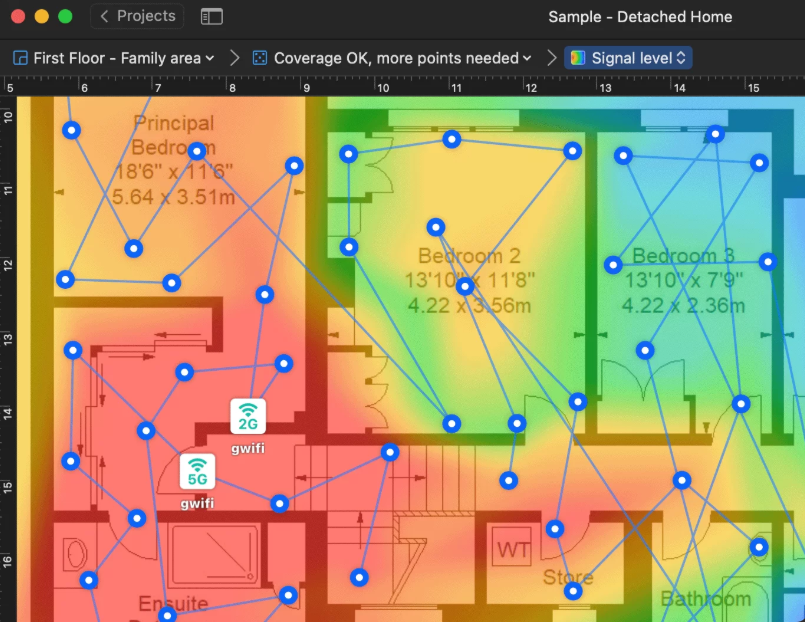
A deployed 5G base station does not necessarily mean it operates according to its committed specifications. The actual outdoor bandwidth measured often deviates significantly from the figures on paper, as it depends on interference, obstacles, distance, and field beamforming behavior. For network operators, system integrators, or research laboratories, the lack of suitable testing tools means being unable to verify coverage quality before handover or failing to detect configuration errors until end customers complain.
IKAM deploys bandwidth and network performance testing solutions based on RF test equipment lines, serving everything from field testing of base stations to signal analysis in laboratory environments.
The most common answer in the telecommunications industry is a handheld spectrum analyzer capable of simultaneously scanning multiple network technologies—from 2G, 3G, and 4G to 5G NR—to compare power levels and interference conditions across overlapping frequency bands. FieldFox-type devices belong to this category, integrating spectrum analysis, vector network analysis, and cable/antenna testing into a single handheld unit. This allows engineers to check channel power, standing wave ratio (VSWR), or cable loss directly at the base of the tower without hauling bulky lab equipment into the field.
For sub-6GHz coverage base stations, this tool is sufficient to determine whether actual coverage matches the design model and to detect co-channel interference between newly installed stations and surrounding legacy infrastructure early on.

The biggest difference lies in how 5G NR utilizes wider bandwidths and beamforming techniques to focus signals directly toward users rather than broadcasting uniformly like previous network generations. As a result, measuring power at a single point no longer accurately reflects coverage quality across the entire area, since signal strength depends on whether the beam is directed toward the measurement location.
For base stations utilizing phased array antennas and massive MIMO technology, evaluating performance requires combining overall power measurement with time-domain beamforming behavior analysis—a far more complex form of testing than simply reading a dBm figure as before.
In the laboratory, engineers require high precision to analyze signal quality in detail. Measurements such as error vector magnitude (EVM) or physical channel coding verification demand dedicated vector signal analyzers, typically paired with analysis software to examine the detailed 5G NR signal structure down to the frame level.
In the field, speed and mobility take precedence over absolute detail. Handheld devices like the FieldFox are designed specifically for this context: fast-measuring, portable, and sufficiently accurate for making on-site operational decisions without needing to bring samples back to the lab for re-analysis.
A practical limitation should be noted: 6G-oriented measurements involving ultra-wide modulation bandwidths in the millimeter-wave and sub-terahertz bands require specialized setups, such as wideband vector signal generators paired with ultra-high sample rate oscilloscopes. Most of these remain in the research and development phase within chipmaker and network equipment labs, rather than serving as common test items at commercial deployment scales.
For the 5G infrastructure currently operating in Vietnam, the majority of testing needs remain within the sub-6GHz range—precisely the scope that FieldFox devices and field signal analyzers can effectively address.