While AI model training clusters represent millions of dollars in GPU hardware investments, actual computing throughput depends heavily on a frequently overlooked component: the inter-GPU interconnect network. A single congested link or misconfigured switch port can cause dozens of compute engines to enter an idle wait state instead of executing parallel matrix operations. Crucially, these network bottlenecks are difficult to detect via visual checks or standard monitoring tools because the system remains "functional"—it simply operates at a fraction of its true hardware capability.
IKAM deploys comprehensive AI data center network testing solutions powered by Keysight test platforms to validate performance, identify throughput bottlenecks, and verify high-speed interconnect compliance prior to live production deployment.
Large-scale AI model training is not executed on isolated GPUs; it relies on hundreds or thousands of GPUs working synchronously, continuously exchanging parameter weights and gradients across the fabric during training loops. Overall job completion speed depends on whether the interconnect fabric delivers sufficient bandwidth, ultra-low latency, and lossless stability to prevent data pipeline stalls.
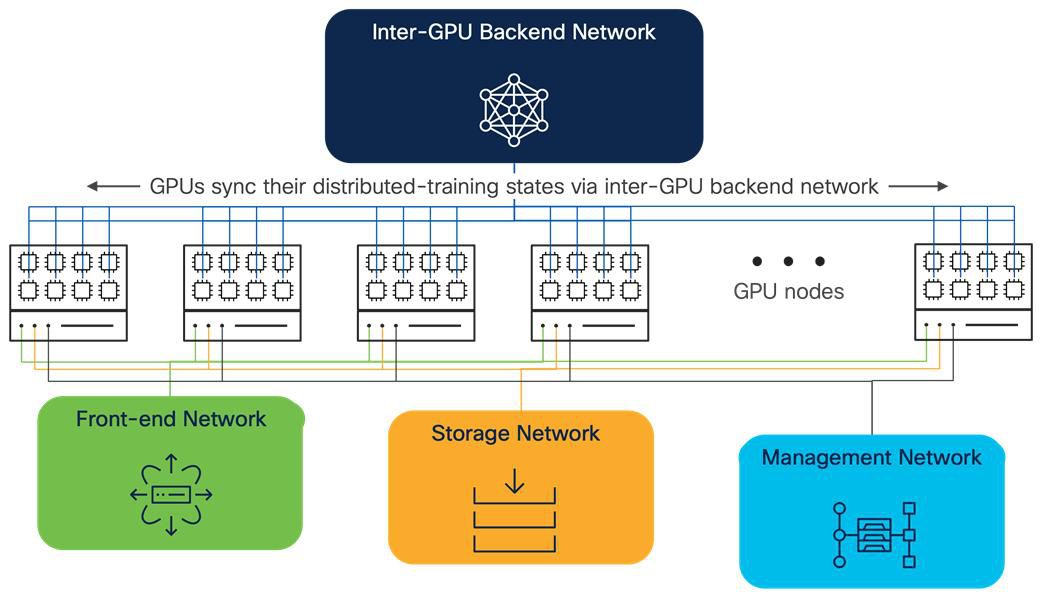
Network degradation rarely presents as a hard system crash. Instead, it manifests as extended training epoch times, leaving up to 50% of processing cores idling while waiting for payload delivery despite healthy hardware metrics. Detecting these silent performance penalties requires structured, systematic network validation rather than basic telemetry observation.
Traditional enterprise networks are architected for bursty, distributed traffic composed of small, independent user sessions. In contrast, AI data center fabrics handle highly synchronized collective communication patterns where massive data flows traverse GPU nodes simultaneously. These fabrics heavily utilize Remote Direct Memory Access (RDMA) protocols to bypass OS kernel overhead and achieve minimal latency.
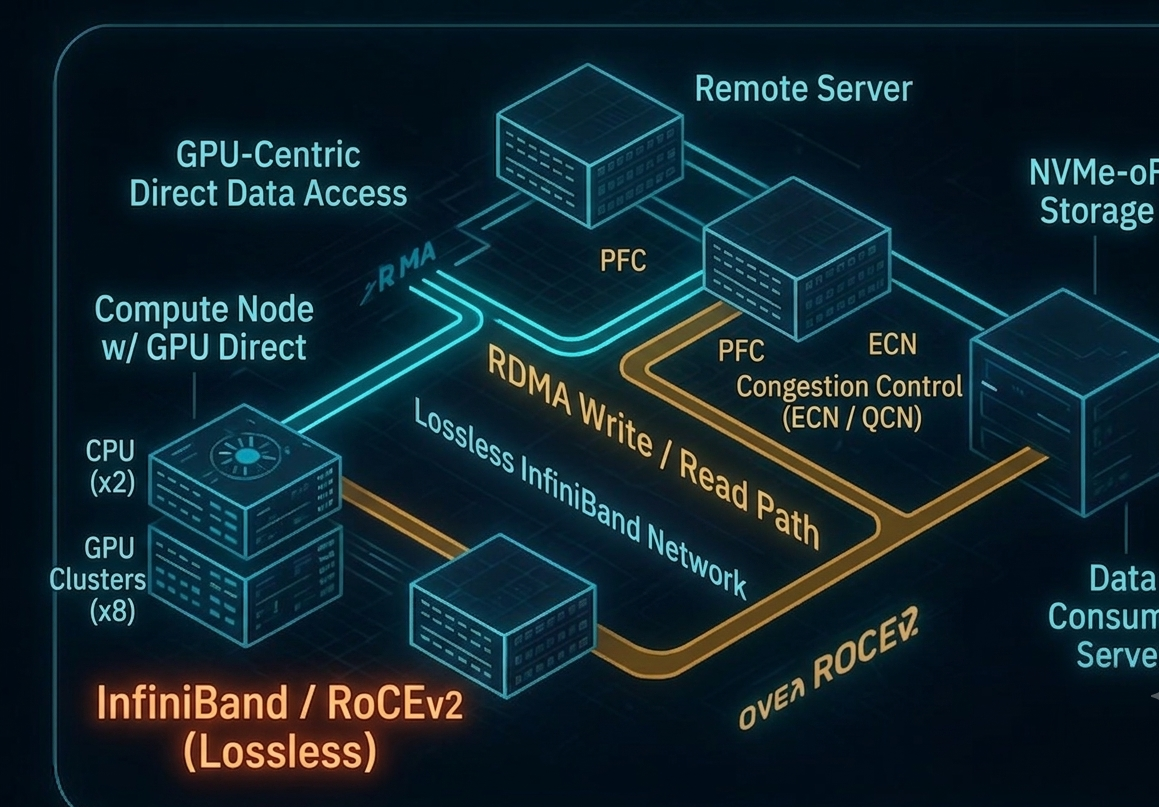
Consequently, testing methodologies must accurately emulate real-world AI workload traffic patterns rather than basic throughput benchmarks. Specialized AI network test platforms simulate multi-job traffic models, stress-test congestion control mechanisms (like PFC and ECN), load balance paths, and verify zero-packet-loss transport under heavy parallel workloads—identifying structural bottlenecks long before live cluster deployment.
In addition to system-level fabric performance, individual physical interconnect components must be validated for standard compliance prior to physical assembly. Next-generation AI infrastructure standards—including advanced PCIe generations, CXL, and 800G/1.6T Ethernet links—impose strict signal integrity requirements.
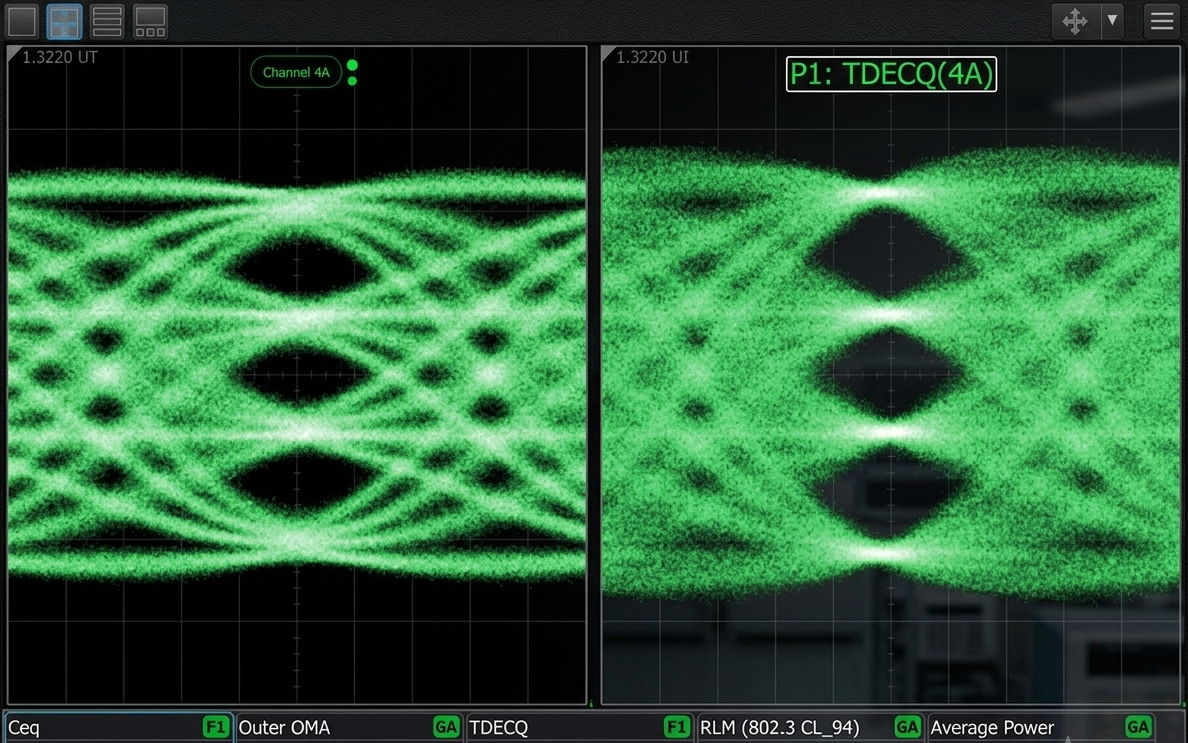
Compliance testing utilizes high-speed physical layer test equipment to verify that optical transceivers, active electrical cables (AEC/DAC), and signal re-timers strictly conform to electrical and optical specifications before deployment into production racks. For network equipment manufacturers and system integrators, this validation prevents post-installation component failures that incur costly teardowns and operational downtime.
This test solution is ideal for network hardware manufacturers, hyperscale data center operators, and organizations building dedicated GPU clusters for AI model training—environments where network efficiency directly impacts operational expenditure (OpEx) and time-to-market.
For small-scale deployments featuring a few AI servers dedicated primarily to inference workloads rather than distributed training, high-tier fabric testing may not be immediately required. Network interconnect bottlenecks become critical specifically when GPU cluster sizes scale to the point where inter-node data synchronization dictates overall compute velocity.
Does AI network testing require shutting down running production systems? Not necessarily. The majority of fabric performance testing and benchmarking is conducted within isolated pre-production environments or dedicated staging pods prior to cluster commissioning, eliminating disruption to active production workloads.
Is it possible to benchmark AI network performance without investing in physical GPU hardware? Yes. Dedicated network emulation platforms simulate the traffic behavior of GPUs and RDMA network interfaces (NICs) using synthetic load appliances, enabling accurate network fabric benchmarking without deploying full physical compute infrastructure.
How long does high-speed interconnect compliance testing take? Execution time varies based on component counts and target standards, ranging from a few hours for a component sample batch to several days for comprehensive multi-protocol compliance validation on complex systems.