Indoor humidity is often overlooked until mold appears on walls, archived documents deteriorate, or metal contacts on electronic equipment begin to corrode. Temperature is no different a drift of just a few degrees from the optimal level can cause employee sluggishness and reduce customer dwell time in retail stores beyond expectation. The issue isn't that facility managers ignore these factors, but rather that continuously monitoring dozens of rooms and hundreds of square meters of warehouse space simultaneously is nearly impossible, leaving problems undetected until tangible damage has occurred.
IKAM deploys environmental monitoring solutions based on LoRaWAN temperature and humidity sensors. Distributed throughout the building, these sensors measure and transmit data to a central platform in real time, detecting anomalies immediately as they occur rather than waiting for visible signs of damage.
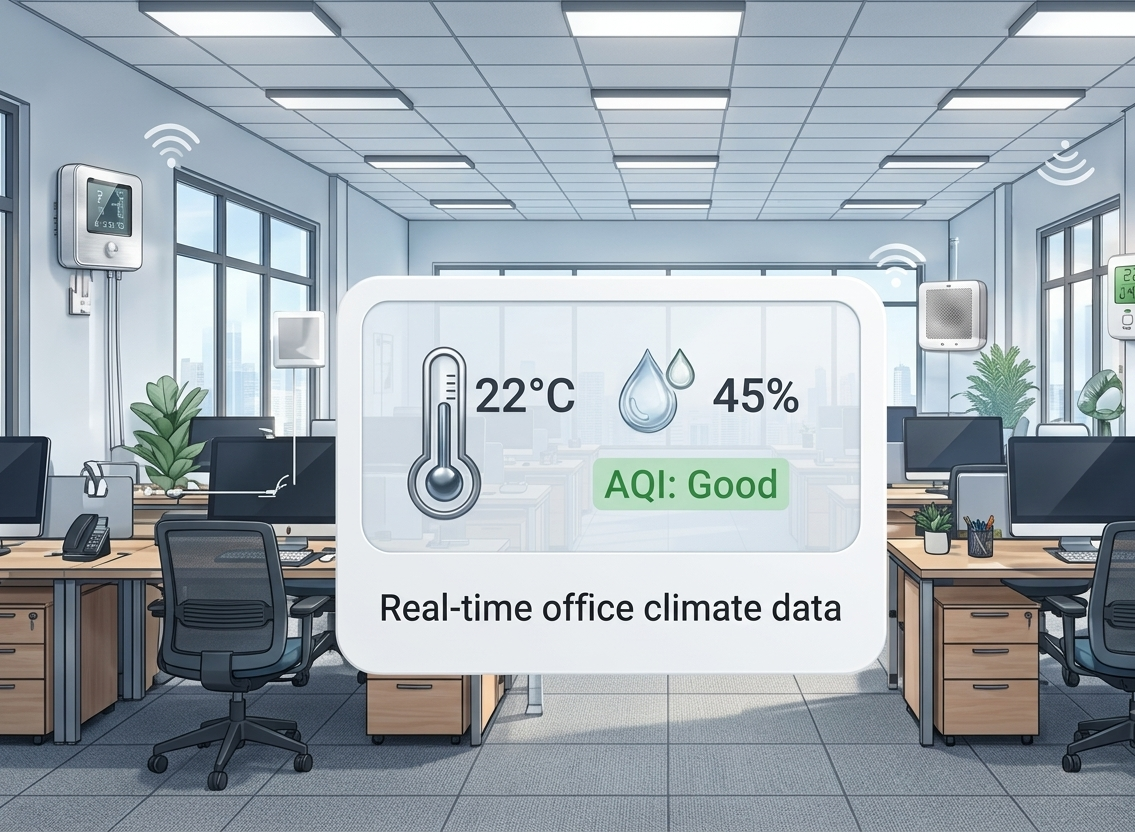
Each sensor is mounted at a fixed location to continuously measure ambient temperature and humidity over customizable intervals, then transmits data via a LoRaWAN network to the control center. For specialized applications requiring direct surface or liquid measurement such as pipelines or storage tanks the sensors support specialized external probes, completely isolated from the main unit to avoid influence from ambient air temperature.
The key advantage is that the device requires a single installation and operates virtually unattended for years. Leveraging high-capacity batteries and the ultra-low power consumption inherent to LoRaWAN technology, battery life can extend up to a decade depending on measurement and transmission frequencyunlike standard Wi-Fi sensors that require recharging or battery replacement every few months.
A continuous stream of temperature and humidity readings holds little value if no one is monitoring it around the clock. The true value of the system lies in configuring custom threshold alerts for each zone for instance, ensuring document storage humidity does not exceed a set limit or server room temperatures remain within a safe range. The moment a reading breaches a threshold, an alert is dispatched to personnel before conditions persist long enough to cause actual damage.
This approach fundamentally shifts maintenance operations from fixed-schedule routine inspections which risk detecting issues too late or performing redundant checks when conditions are normal to a purely condition-based response executed precisely when and where an anomaly occurs.
In commercial buildings, real-time temperature and humidity data serves as an intelligent input for HVAC systems, allowing cooling power to scale dynamically only in overheating areas rather than operating uniformly across the entire facility, driving significant long-term energy savings. For offices and retail environments, maintaining stable climate conditions directly impacts occupant comfort—a subtle yet practical factor driving productivity and customer experience.
On a broader scale, environmental monitoring is not an isolated function but a foundational data layer for virtually all facility operation decisions. From equipment maintenance and asset protection to energy optimization, every action relies on knowing exact real-time environmental conditions based on actionable data rather than human perception or guesswork.