Industry is shifting strongly toward sustainable development, and wastewater quality control is no longer merely an environmental protection obligation but has gradually become a measure of governance capacity for businesses and modern Industrial Parks.
The automated wastewater monitoring system, applying the industrial IoT platform, helps operating units fully meet legal requirements, control costs, and proactively prevent risks throughout the operational process.
Every day, industrial parks discharge tens of thousands of cubic meters of water, while the centralized treatment system always faces the risk of abnormal chemical concentration fluctuations from discharging factories. Traditional manual sampling and testing methods have gradually revealed limitations: failing to keep pace with real time, prone to errors, and reacting slowly when incidents occur.
This is also why Decree No. 08/2022/NĐ-CP and Circular No. 10/2021/TT-BTNMT stipulate that companies and enterprises are required to install continuous automated monitoring stations, transmitting data 24/7 directly to the server system of the Department of Natural Resources and Environment.
Industrial wastewater is currently one of the most severe water pollution agents, leaving consequences across multiple aspects: from human health and local economy to business image.
▪ Impact on human health: Heavy metals such as lead, mercury, and arsenic enter the body through the food chain, increasing the risk of critical illnesses, birth defects, and neurological poisoning in certain residential areas living long-term near polluted basins. Persistent foul odors and turbid black water sources also significantly affect residents' lives and mental health.
▪ Economic Impact (Agriculture, Aquaculture, Tourism): A sharp drop in dissolved oxygen (DO) concentration causes massive fish and shrimp mortality, damaging thousands of hectares of rice and crops. Many rivers that once served as eco-tourism destinations gradually lose their appeal due to polluted water sources, entailing a decline in tourism income and the livelihoods of local residents.
▪ Legal & Brand Impact: A wastewater discharge incident can rapidly turn into a communication crisis. Businesses face heavy administrative fines, the risk of asset freezing, suspension of operations, and long-term loss of reputation with partners and customers.
With such repercussions, proactively investing in a monitoring system to detect and address incidents early is no longer an option, but a necessary condition for businesses to maintain stable operations.
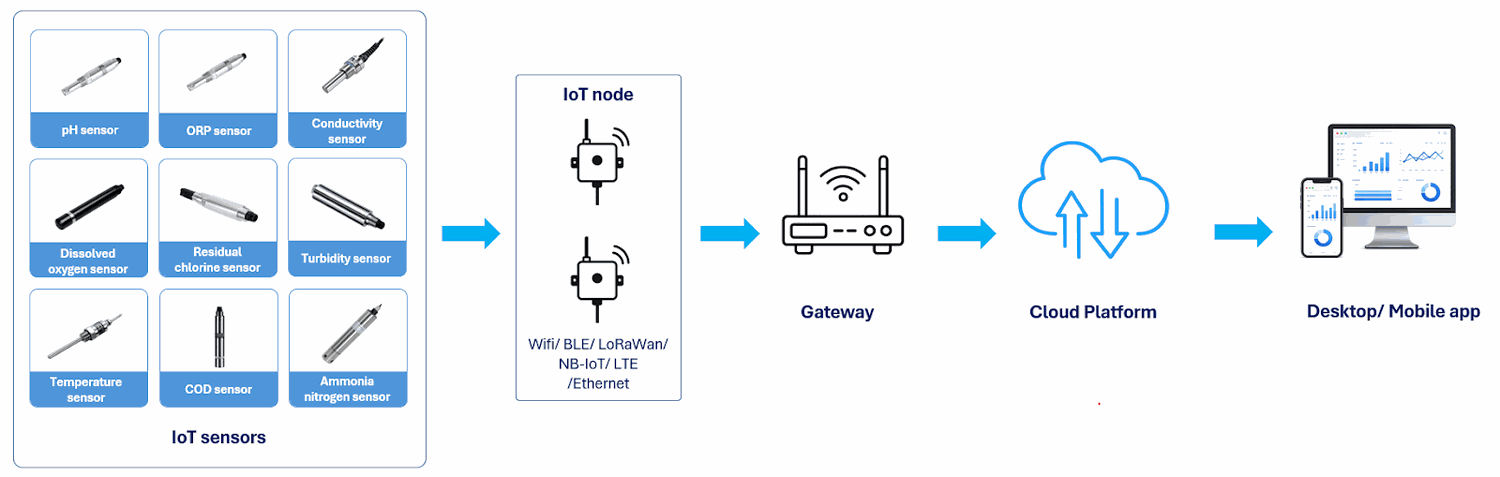
The IoT-applied wastewater monitoring system is designed as a closed, compact model with minimal manual intervention. The system workflow operates through 4 main stages:
▪ Stage 1 - Data Collection (IoT Sensors): Sensors are installed directly at the discharge pit, continuously measuring critical biochemical parameters of the water.
▪ Stage 2 - Data Packaging & Communication (IoT Node & Gateway): Raw data from sensors is transmitted to IoT nodes. From here, the central Gateway receives, encodes signals, and transmits them via various protocols depending on infrastructure conditions: Wi-Fi, BLE, LoRaWAN, NB-IoT, LTE (4G) or Ethernet cables.
▪ Stage 3 - Cloud Platform: Data is stored on cloud servers (Big Data) and automatically cross-referenced in real time with safety thresholds stipulated by law.
▪ Stage 4 - Monitoring & Alarming (Desktop / Mobile App): Indicators are visually displayed on screens at the business operation center and on the mobile app. Upon detecting out-of-threshold metrics, the system triggers alarms and sends SMS messages for timely personnel handling.
To truly and accurately reflect the status of wastewater quality, the monitoring station needs to be equipped with standard-compliant probes. Below are the essential sensor types for the entire system:
▪ pH Sensor: Monitors the acidity or alkalinity of water, helping to early detect pipeline corrosion risks and protect downstream microbial communities.
▪ Dissolved Oxygen Sensor (DO): Measures the amount of oxygen microorganisms need to decompose organic matter in water. When wastewater with high BOD levels is discharged into rivers and lakes, dissolved oxygen levels drop, directly affecting fish and aquatic life. Therefore, treating and reducing BOD before discharging into the environment is a crucial step to keep in mind. (BOD levels in domestic wastewater typically fluctuate around 200 mg/L).
▪ Turbidity Sensor: Detects abnormal increases in suspended solid particles and silt - a sign that the factory's membrane filtration system may be experiencing issues.
▪ Temperature Sensor: Monitors the temperature of the discharge flow, avoiding "thermal shock" to the living environment of fish and shrimp.
▪ Conductivity Sensor (EC): Quickly detects residual mineral salt ions and dissolved metals, providing early warnings of chemical solvent leakage risks.
▪ Chemical Oxygen Demand Sensor (COD): Measures the concentration of polluting organic matter. Exceeded COD levels indicate that the central wastewater treatment microbial tanks are overloaded.
▪ Ammonia Nitrogen Sensor: Closely monitors ammonium concentrations in water. Excess ammonium can cause plant toxicity, water source pollution, and degradation of aquatic environmental quality.
▪ ORP Sensor (Oxidation-Reduction Potential): Measures the pollutant decomposition capacity of water - a vital parameter when controlling wastewater treatment processes using disinfecting chemicals.
▪ Residual Chlorine Sensor: Monitors remaining chlorine after wastewater disinfection, ensuring it does not exceed harmful limits for the ecosystem when water is discharged into the natural environment.
Investing in an automated monitoring system not only helps businesses meet legal requirements and contribute to environmental protection, but also brings long-term financial and brand benefits:
▪ Avoiding Legal Risks: Helps businesses comply with environmental laws, avoiding heavy administrative fines or the risk of operational suspension.
▪ Proactive Risk Management: Continuously monitors parameters such as pH, COD, and flow rate in real time 24/7, facilitating early detection of pollution incidents and timely handling plans.
▪ Optimizing Operational Costs: Based on accurate data from sensors, environmental engineers can precisely adjust the dosage of chemicals pumped into treatment tanks, reducing monthly material budget waste.
▪ Enhancing Brand Reputation: Building a transparent database, supporting businesses in practicing sustainable development standards (ESG) well and strengthening trust with partners.
An automated, continuously operating wastewater monitoring system is gradually becoming an indispensable part of the operations of modern Industrial Parks, companies, and enterprises. The combination of specialized sensors and IoT control platforms empowers investors to proactively prevent legal risks while contributing to protecting public health, preserving livelihoods and living environments for future generations.